Score: 5.00 Votes: 4
rate this

The Citroën DS, aka "La Déesse" (godess in French)

Starter: groezel Posted: 19 years ago Views: 718
#2358872
Lvl 21
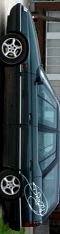
The Citroën DS (also known as Déesse, or Goddess, after the punning initials in French) was an automobile produced by the French manufacturer Citroën between 1955 and 1975. Citroën sold nearly 1.5 million D-series during its 20 years of production.The DS is well-known for its futuristic, aerodynamic body design, and for its innovative technology (including its hydropneumatic self-leveling suspension system).

The DS advanced the achievable standards in terms of ride quality, roadholding, handling, and braking in an automobile. Automotive journalists of the time often noted that competitors took decades to adapt to the higher standards it set. The smooth, aerodynamic body lines gave the car a futuristic appearance. While it looked very unusual in 1955, public tastes appear to have caught up with the DS in the post-Ford Taurus/Audi 100 era.
* This post has been modified : 19 years ago
#2358873
Lvl 21
Technical details


Drivetrain

For such a modern car, the engine of the original DS 19 was very old-fashioned. It was derived from the engine of the 11CV Traction Avant (models 11B and 11C). It was an OHV four-cylinder engine with three main bearings and dry liners, and a bore of 78 mm and a stroke of 100 mm, giving a volumetric displacement of 1911 cc. The cylinder head had been reworked; the 11C had a reverse-flow cast iron cylinder head and generated 60 hp at 3800 rpm; by contrast, the DS 19 had an aluminium cross-flow head with hemispherical combustion chambers and generated 75 hp at 4500 rpm. Apart from these details, there was very little difference between the engines: even the locations of the cylinder head studs were the same, so that it was possible to put the cylinder head of a DS on a Traction Avant engine and run it.

Like the Traction Avant, the DS had the gearbox mounted in front of the engine, with the differential in between. It initially had a four-speed manual transmission and a hydraulic clutch. This is sometimes incorrectly referred to as a semi-automatic; in fact, the transmission and clutch themselves were identical to the units first introduced with the ID19. The only difference was the means of control. Later a five-speed manual was introduced, which replaced the original four-speed unit.

Hydraulic system

The hydraulic system of the DS 19 was a revolution. Previously hydraulics had been restricted to use in brakes and power steering; the DS used them for the suspension, clutch and transmission.


Suspension

The most remarkable aspect of the hydraulic system was its use in the car's suspension system. Each wheel was connected not to a spring, but to a hydraulic suspension unit consisting of:

* a sphere of about 12 cm in diameter containing pressurised nitrogen
* a cylinder containing hydraulic fluid screwed to the suspension sphere
* a piston inside the cylinder connected by levers to the suspension itself
* a damper valve between the piston and the sphere

A membrane in the sphere prevented the nitrogen from escaping. The motion of the wheels translated to a motion of the piston, which acted on the oil in the nitrogen cushion and provided the spring effect. The damper valve took place of the shock absorber in conventional suspensions.

The hydraulic cylinder was fed with hydraulic fluid from the main pressure reservoir via a height corrector, a valve controlled by the mid-position of the anti-roll bar connected to the axle. If the suspension was too low, the height corrector introduced high-pressure fluid. If it was too high, it released fluid back to the fluid reservoir. In this manner, it maintained a constant height. A control in the cabin allowed the driver to select one of five heights:

* Normal riding height.
* Two slightly higher riding heights, for poor terrain.
* Two extreme positions for changing wheels.

The DS did not have a jack for lifting the car off the ground. Instead, the hydraulic system enabled wheel changes with the aid of a simple adjustable stand.
* This post has been modified : 19 years ago
#2358874
Lvl 21
Hydraulic fluid

The original hydropneumatic system used a vegetable oil (LHV or liquide hydraulique végétale) similar to that used in other cars at the time. Very soon, Citroen changed to using a synthetic fluid (LHS or liquide hydraulique synthétique). Both of these had the disadvantage that the hydraulic components were subject to relatively rapid deterioration, requiring expensive maintenance work. In August 1967, Citroen introduced a new mineral-based fluid LHM, or liquide hydraulique minérale. This fluid was much less aggressive on the system, and it remains in use to the present day. It required completely different materials for the seals, however. Using either fluid in the incorrect system would completely destroy the hydraulic seals very quickly. To help avoid this problem, Citroen added a bright green dye to the LHM fluid and also painted all hydraulic elements bright green.

Several different hydraulic pumps were used. The original one was a seven-cylinder eccentric pump driven off two belts and delivering 175 atm of pressure. The ID19, with its simpler hydraulic system, used a single cylinder pump.


Gearbox and clutch

The mechanical aspects of the gearbox and clutch were completely conventional, and the same elements were used in the ID 19.

The gear change control consisted of:

* Hydraulic gear selector.
* Clutch control. This was the most complicated part. The speed of engagement of the clutch was controlled by:
o A centrifugal regulator, sensing engine rpm and driven off the camshaft by a belt
o The position of the butterfly valve in the carburettor (i.e. the position of the accelerator)
o The brake circuit: when the brakes were pressed, the clutch disengaged at a higher rpm, thus preventing friction while stopped in gear at traffic lights
* This post has been modified : 19 years ago
#2358875
Lvl 21

DS in the US

While the DS was a hit in Europe, it seemed rather odd in the US. Ostensibly a luxurious car, it didn't have the basic features that Americans of that era expected to find on such a vehicle - fully automatic transmission, air conditioning, power windows, and a reasonably powerful engine. Also, Americans at the time wanted to only search for the newest models, which changed every year, like fashion, yet for Americans the DS appeared vaguely derivative of the 1950 Hudson Hornet step-down design. Outdated US legislation also banned some of the car's more advanced features, such as the LHM hydraulic mineral fluid and the aerodynamic headlights, both now common in US automobiles. Ultimately, 38,000 units were sold.


Design variations

The DS always maintained its size and shape, with easily removable, unstressed body panels, but certain design changes did occur.

A station wagon version was introduced in 1958 - it was known by various names in different markets (Break in France, Safari and Familiale in the UK, Wagon in the US, while Citroen Australia used the term Safari and Station-Wagon).

In September 1962, the DS was restyled with a more aerodynamically efficient nose, better ventilation and other improvements. It retained the open two headlight appearance, but was available with an optional set of driving lights mounted on the front fenders. In 1965 a luxury upgrade kit, the DS Pallas (after Greek goddess Pallas), was introduced. This included comfort features such as better noise insulation, leather upholstery and external trim embellishments.

In 1967, the DS and ID was again restyled. This version had a more streamlined headlight design, giving the car a notably shark-like appearance. This design had four headlights under a smooth glass canopy, and the inner set swivelled with the steering wheel. This allowed the driver to see around turns, especially valuable on twisting roads driven at high speed at night.

This feature was not allowed in the USA at the time, so version with four exposed headlights that did not swivel was made for the US market.

The station wagon edition, the Break (called the ID Safari on the UK market) and "Familiale", was also upgraded. The hydraulic fluid changed in all markets (except the US) to the technically superior LHM (Liquide Hydraulique Minérale).

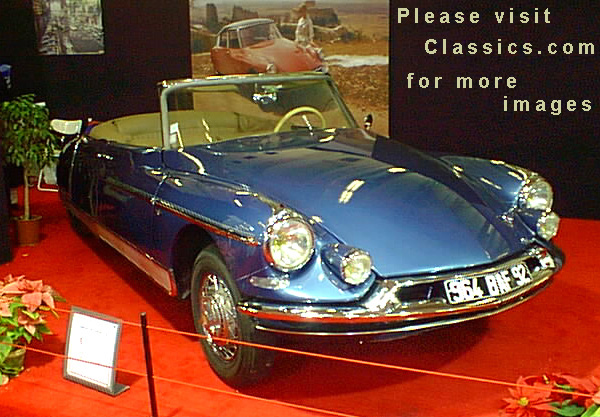
Rarest and most collectible of all DS variants, a convertible was offered from 1958 until 1973. The convertibles were built in small series by French carrossier Henri Chapron, for the Citroën factory. In addition, Chapron also produced a few coupés, non-works convertibles and special sedans (DS Lorraine for instance).
* This post has been modified : 19 years ago

#2358876
Lvl 16
Very cool.

Another very advanced car for its time sounds like from an engineering and desgin standpoint.
* This post has been modified : 19 years ago
#2358877
Lvl 21
it's not quite a tucker but i think it could be considered it's little european brother!
* This post has been modified : 19 years ago
#2358878
Lvl 16
I found a good pic of the turning inside headlights....

* This post has been modified : 19 years ago
#2358879
Lvl 21
when i was lookin' for pics of that, google kept askin' if i meant 'tuning' head lights!
* This post has been modified : 19 years ago
#2358880
Lvl 16
Quote:
Originally posted by groezel

when i was lookin' for pics of that, google kept askin' if i meant 'tuning' head lights!


I fixed the link on the pic above.
* This post has been modified : 19 years ago
#2358881
Lvl 16
Here's that Chapron Cabriolet. She's a beauty...

* This post has been modified : 19 years ago
#2358882
Lvl 21
nice pic there, it shows what innovative car it was way back then...
but over time some things break down on cars (shit happens) and if you had bad luck those lights could end up "cross eyed"
but if you drive through holland, you'd be surpised how many of these are still on the road!
* This post has been modified : 19 years ago
#2358883
Lvl 21
another henri chapron body, with trunk(!)
* This post has been modified : 19 years ago
#2358884
Lvl 21
http://www.whatboyswant.com/caroverview/1535
all the godesses can be viewed here
* This post has been modified : 19 years ago
#2358885
beautiful car!
* This post has been modified : 19 years ago
#2358886
Lvl 16
Indeed. Great thread groezel.
* This post has been modified : 19 years ago
#2358887
Lvl 9
i'm a big fan of the DS ever since i got a ride in one when hitchhinking... the smooth ride that is, it's almost unfuckingbelievable...
to be honest the three door version by Henri Chapron isn't as good lookin' as the "standard" DS or iD... but those convertibles, man, they make me drool!
by the way groezel, almost every single DS in the database of WBW is uploaded by you!
* This post has been modified : 19 years ago
#2358888
Lvl 21
@ghengis, yeah, they are very close to my all time favourite... so why not a major upload?
* This post has been modified : 19 years ago
#2358889
Lvl 12
I always thought the DS was ugly, until I saw the pic of the cabriolet. Stunning design.
* This post has been modified : 19 years ago
#2358890
Lvl 21
another view on those turnin' headlights...

http://www.whatboyswant.com/showcar/19590/1535/
yes, there are people out there who so obsessed with these godesses that they have a matchin' caravan
* This post has been modified : 19 years ago